4-Week At-Home Workout Plan: Daily Workouts + Stretches
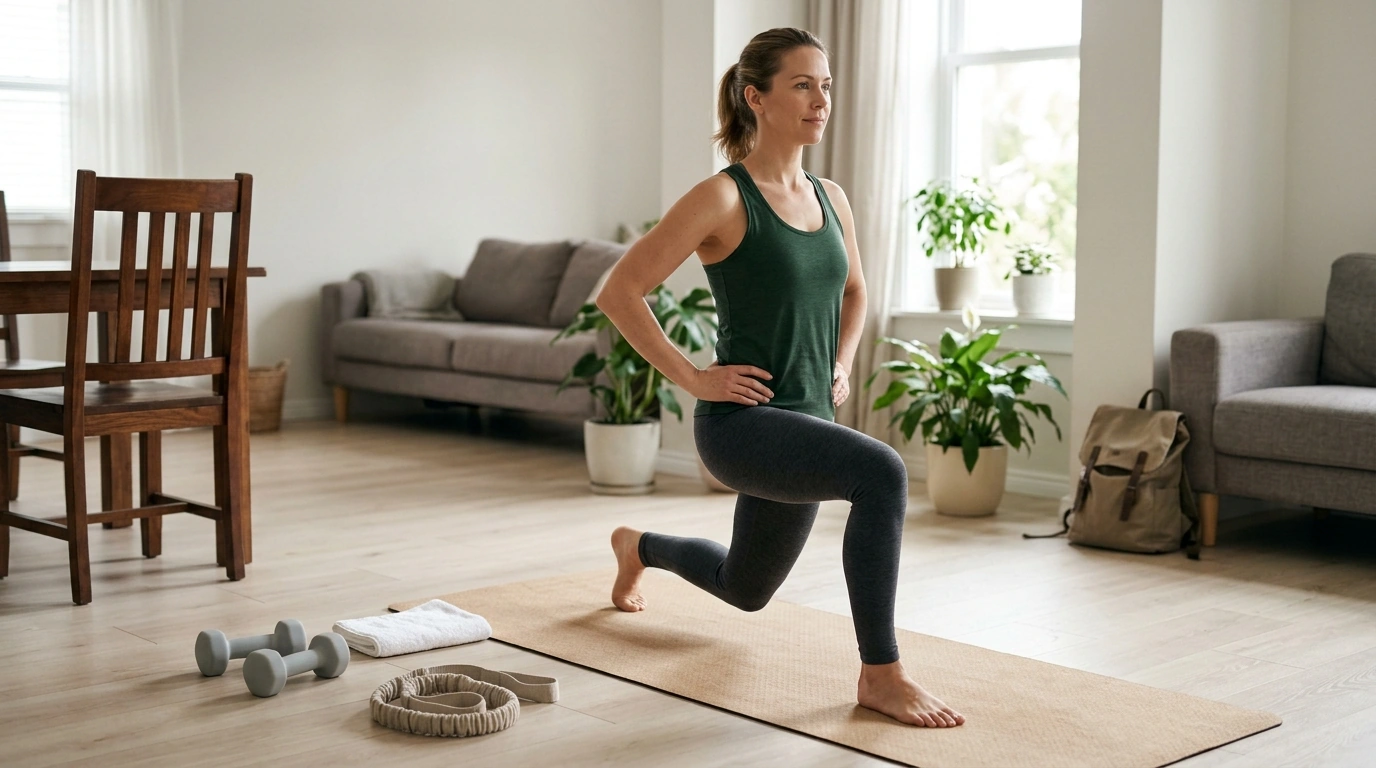
Fit at Home: A 4-Week Plan With Minimal Equipment (Daily Workouts + Stretches)
A simple four-week routine can build strength, improve conditioning, and reduce stiffness—without a full gym setup. The key is a repeatable weekly rhythm, clear daily themes, and short stretch sessions that stay realistic on busy days while still progressing week to week.
What to Expect From the 4-Week Schedule
- Time commitment: about 20–40 minutes most days, with at least one lighter, recovery-focused day each week.
- Training balance: lower body, upper body, core, and full-body conditioning spaced across the week so nothing gets neglected.
- Progression: small weekly upgrades—more reps, an extra set, slower tempo, or slightly shorter rest.
- Options for all levels: beginner-friendly modifications plus intensity upgrades when you’re ready.
For general health benchmarks, the Physical Activity Guidelines for Americans (2nd edition) recommend regular aerobic activity and muscle-strengthening work—this plan supports both with minimal gear.
Minimal Equipment Setup (And Smart Substitutions)
- Primary essentials: an exercise mat, a sturdy chair or couch edge, and optional resistance band or light dumbbells.
- Household swaps: a backpack loaded with books for resistance; towels as hamstring sliders on smooth floors.
- Space needs: a clear area about the size of a yoga mat plus arm’s reach.
- Safety basics: stable footing (barefoot traction can work well), a clear floor, and a chair that won’t slide.
| Goal | Minimal Equipment | Household Alternative |
|---|---|---|
| Add resistance | Resistance band or light dumbbells | Backpack with books or water bottles |
| Support for pressing | Chair or bench | Couch edge (stable) |
| Core + mobility | Mat | Carpet or folded towel |
| Hamstring/posterior chain | Slider discs | Towels on tile/wood |
Weekly Structure (Repeat for 4 Weeks)
- Day 1: Lower-body strength + core finisher (squat/lunge emphasis)
- Day 2: Upper-body strength + posture work (push/pull balance)
- Day 3: Conditioning (low-impact intervals) + mobility
- Day 4: Full-body strength circuit (moderate pace, controlled form)
- Day 5: Glutes/hamstrings + core stability (hinge emphasis)
- Day 6: Recovery day (walk + longer stretch session)
- Day 7: Optional: short cardio, yoga flow, or complete rest depending on fatigue
| Day | Focus | Main Moves | Stretch Focus |
|---|---|---|---|
| 1 | Lower + core | Squat pattern, split squat, calf work | Hips, quads |
| 2 | Upper + posture | Push-ups, rows, shoulder stability | Chest, lats |
| 3 | Conditioning + mobility | Intervals, core breathing | Full-body mobility |
| 4 | Full-body circuit | Squat/hinge/push/pull rotation | Glutes, thoracic spine |
| 5 | Posterior chain + core | Hip hinge, hamstrings, anti-rotation | Hamstrings, hip flexors |
| 6 | Recovery | Walk or gentle movement | Longer full-body stretch |
| 7 | Optional/rest | Easy cardio or rest | Light stretch as needed |
Daily Session Format (Keep It Consistent)
- Warm-up (3–6 minutes): light cardio + joint circles + movement prep (bodyweight squats, arm swings, hip hinges).
- Main work (12–25 minutes): 2–4 blocks of strength sets or a circuit.
- Finisher (3–8 minutes): optional short burst (core, carries, or intervals) based on energy and time.
- Cool-down stretch (5–10 minutes): focus on the muscle groups trained that day.
- Rule of thumb: stop 1–2 reps before form breaks; clean reps beat rushed reps.
For strength training guidance and safety basics, the American College of Sports Medicine (ACSM) resistance training resources emphasize consistent effort, good technique, and sensible progression—exactly what this four-week structure supports.
Progression Plan: How Each Week Gets Harder
- Week 1: learn form, choose manageable variations, and keep rest generous.
- Week 2: add a set to 1–2 main exercises or add 2–3 reps per set.
- Week 3: shorten rest by 10–20 seconds or use a harder variation (incline push-up → floor push-up).
- Week 4: use a benchmark day—repeat a Week 1 workout and compare reps, tempo control, or perceived effort.
- Deload option: if fatigue stacks up, keep Week 4 intensity but reduce volume by about 20–30%.
| Method | Example | Best For |
|---|---|---|
| Add reps | 8 reps → 10 reps | Strength endurance |
| Add sets | 2 sets → 3 sets | Strength and volume |
| Slow tempo | 3 seconds down on squats | Control and joint friendliness |
| Reduce rest | 60s → 40s between rounds | Conditioning |
| Harder variation | Knee push-up → full push-up | Strength gains |
Stretching and Mobility (Daily, Short, Effective)
- Post-workout stretches: hold 20–40 seconds per position, 1–2 rounds.
- Key desk-life areas: hip flexors, hamstrings, chest, upper back.
- Breathing: inhale through the nose, slow exhale to reduce tension and improve range.
- Intensity: aim for mild-to-moderate stretch sensation—avoid forcing end ranges.
Quick Stretch Menu by Focus Area
- Hips: hip flexor lunge stretch, figure-4 glute stretch (best after lower-body days)
- Hamstrings: standing hamstring hinge, towel hamstring stretch (best after hinge/posterior chain work)
- Chest/shoulders: doorway pec stretch, cross-body shoulder stretch (best after upper-body days)
- Back: child’s pose, thoracic rotation (great after circuits or conditioning)
Staying Consistent: Time-Saving Adjustments
Even modest daily movement adds up—regular activity supports heart health, strength, and mood, as summarized by the CDC’s benefits of physical activity.
Digital 4-Week Plan PDF: What’s Included
Recommended downloads:
Fit at Home: 4-Week Workout Plan (PDF)
and, for recovery support,
Sleep Reset: Guided Audio Course for Restful Nights.
FAQ
How long should each daily workout take?
Plan on about 20–40 minutes. On busy days, keep the warm-up and one main block, then finish with a quick 5-minute stretch—consistency beats a “perfect” session.
Can this plan work with no equipment at all?
Yes. Use bodyweight-only progressions like slower tempo, pauses, and single-leg variations; if you want extra challenge, a backpack with books can add resistance without buying gear.
How many rest days are needed each week?
At least one lighter recovery day is a good baseline. Add more rest if sleep quality drops or soreness lingers; walking and gentle mobility work are effective forms of active recovery.












Leave a comment